Research story · 02
How drugs rewrite the reward system
Cocaine and morphine change how reward neurons read their genes, and in mice some of those changes outlast the drug. We study those marks, cell type by cell type.
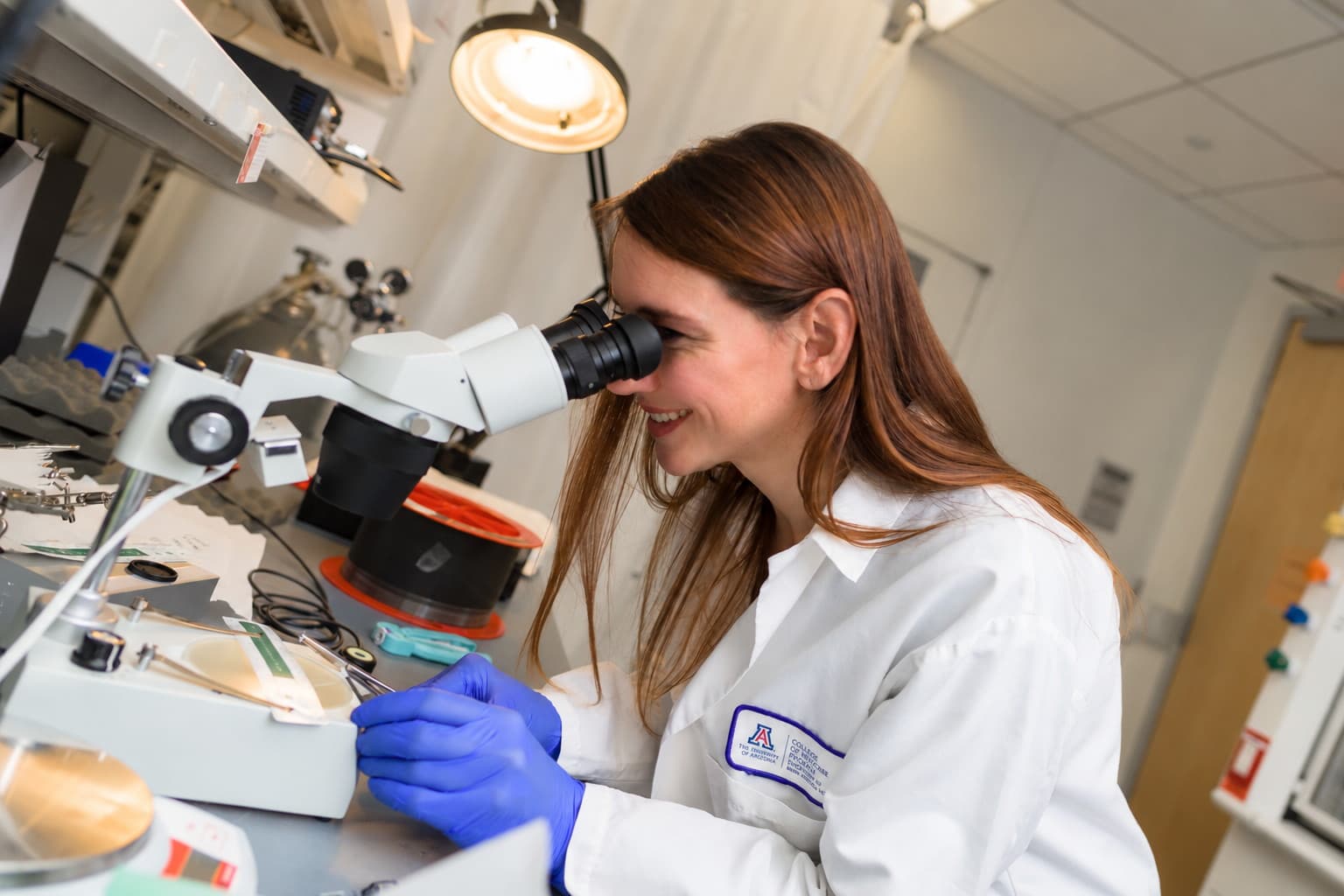
Photo: UA College of Medicine – Phoenix Media Productions, 2017
The question
How do drugs of abuse change the brain's reward circuits, and why do the changes last?
Drugs like cocaine and morphine hijack the nucleus accumbens, the part of the brain that learns what feels good. They change the chemical tags on DNA and its packaging, the epigenome, which changes which genes switch on, and some of those changes last long after the drug is gone.
The story · 2:22
What Drugs Leave Behind
How cocaine and morphine change the way reward neurons read their genes, and why some of those changes outlast the drug.
Chapters
- Featured studies
- Ferguson et al., J Neurosci 2013 · Ferguson et al., J Neurosci 2015 · Heller et al., Nat Neurosci 2014 · Feng et al., Nat Neurosci 2015
- Where
- These studies began in Eric Nestler's lab at the Icahn School of Medicine at Mount Sinai; the 2015 paper was completed with the Arizona lab
- Current work
- Arizona Biomedical Research Centre Investigator Grant
- Brain model
- Allen Mouse Brain Common Coordinate Framework v3, Allen Institute for Brain Science
Big questions
What we want to know
- 01How do cocaine and opioids change gene activity inside specific reward neurons?
- 02Why do some drug-induced changes last long after drug use stops?
- 03How do the brain's daily clock genes shape vulnerability to addiction?
- 04Can targeted epigenetic editing reverse drug-induced changes?
- 05Why do stress and addiction so often travel together?
Including work from Dr. Ferguson's postdoctoral training
Key papers
J Neurosci · 2013
Essential role of SIRT1 signaling in the nucleus accumbens in cocaine and morphine action
Ferguson D, Koo JW, Feng J, Heller E, Rabkin J, Heshmati M, …, Shen L, Nestler EJ
J Neurosci · 2015
SIRT1-FOXO3a regulate cocaine actions in the nucleus accumbens
Ferguson D, Shao N, Heller E, Feng J, Neve R, Kim HD, …, Shen L, Nestler EJ
Nat Neurosci · 2015
Role of Tet1 and 5-hydroxymethylcytosine in cocaine action
Feng J, Shao N, Szulwach KE, Vialou V, Huynh J, Zhong C, …, Jin P, Nestler EJ
Nat Neurosci · 2014
Locus-specific epigenetic remodeling controls addiction- and depression-related behaviors
Heller EA, Cates HM, Peña CJ, Sun H, Shao N, Feng J, …, Zhang F, Nestler EJ
Science · 2012
BDNF is a negative modulator of morphine action
Koo JW, Mazei-Robison MS, Chaudhury D, Juarez B, LaPlant Q, Ferguson D, …, Han MH, Nestler EJ
Funding
- Arizona Biomedical Research Centre Investigator Grant, Neuronal and Circuit-Specific Maladaptations Contributing to Cocaine Addiction (2023–2027)
Collaborators
- Qiu Lab, UA College of Medicine – Phoenix
- Jin G. Park, Arizona State University (circadian biology)