Research story · 04
From mouse to human
We grow brain organoids from human stem cells to ask whether what we find in mouse reward circuits holds in human neurons.
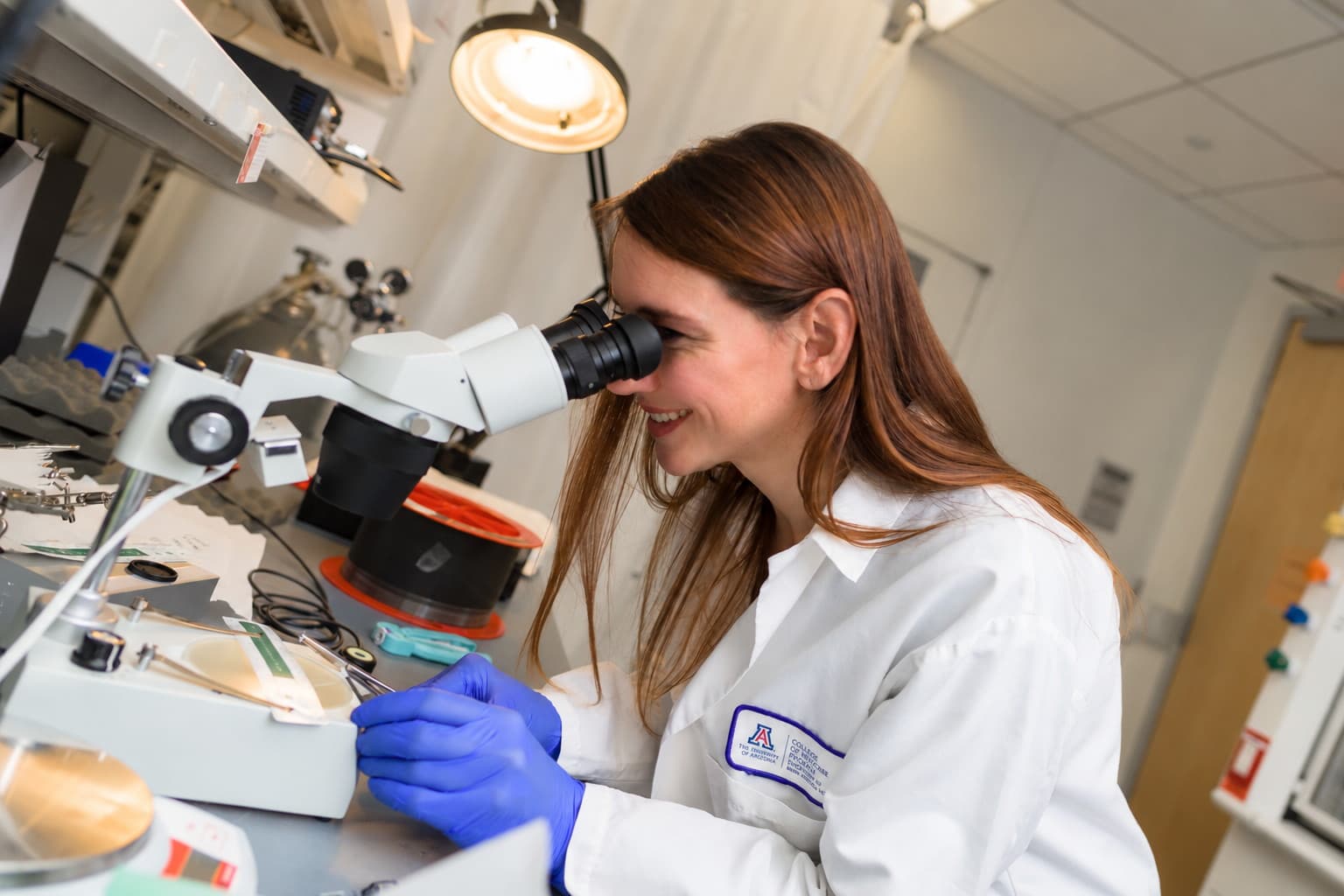
Photo: Adam Brooks, UA College of Medicine – Phoenix Media Productions, 2020
The question
Do the mechanisms we find in mouse reward circuits hold in human neurons?
Stem cells made from a person's blood or skin can be grown into neurons and brain organoids that carry that person's genetics. In 2026 we signed agreements with the National Institute of Mental Health and the Salk Institute for stem-cell lines from research donors. Our organoids will be grown from the NIMH lines, and we lead a new shared multielectrode-array platform that will record how these human neurons fire.
The story · 2:47
Can what the lab finds in mouse reward circuits be tested in human cells? The brain organoids it grows, what an organoid can and cannot be, and the work ahead.
Chapters
- Featured studies (mice)
- Kim et al., J Neurosci 2016 · Kim et al., Mol Psychiatry 2021 · Kim et al., Biol Psychiatry 2024 · Ma et al., Transl Psychiatry 2026, with the Qiu Lab
- Human cell lines
- Under agreement with the Salk Institute for Biological Studies and the NIMH Human Genetics Branch
- Collaborators
- Won Hee Lee, UA College of Medicine – Phoenix · Qiu Lab, UA College of Medicine – Phoenix
- MEA platform
- UA College of Medicine – Phoenix shared-instrumentation award, 2026 · Deveroux Ferguson (PI), with Shenfeng Qiu, Won Hee Lee and Hee-Dae Kim
- Background science
- Reprogramming, organoid formation and multielectrode recording are other laboratories' work, credited in the film
- Mouse brain
- Allen Mouse Brain Common Coordinate Framework v3, Allen Institute for Brain Science
- Human brain
- MNI ICBM152 2009c template, McConnell Brain Imaging Centre, Montreal Neurological Institute, McGill University (Fonov et al., NeuroImage 2011). Copyright (C) 1993–2004 Louis Collins, McConnell Brain Imaging Centre, Montreal Neurological Institute, McGill University
- Funding
- Research supported by the National Institute of Mental Health
Big questions
What we want to know
- 01Do the mechanisms we found in mice differ in neurons from people whose depression did, or did not, lift on an SSRI antidepressant?
- 02How does an extra or missing copy of 16p11.2 change the way human neurons connect?
- 03Can organoids help test new treatments before they reach patients?
Related work on cortical circuits
Key papers
Neural Regen Res · 2025
MET receptor tyrosine kinase promotes the generation of functional synapses in adult cortical circuits
Cui Y, Ma X, Wei J, Chen C, Shakir N, Guirram H, …, Ferguson D, Qiu S
Funding
- UA College of Medicine – Phoenix shared-instrumentation award: Axion Maestro multielectrode-array platform (2026; Deveroux Ferguson, PI, with Shenfeng Qiu, Won Hee Lee and Hee-Dae Kim)
Collaborators
- Salk Institute for Biological Studies (Fred H. Gage)
- NIMH Human Genetics Branch (Francis J. McMahon)
- Won Hee Lee, UA College of Medicine – Phoenix (brain organoids)
- Qiu Lab, UA College of Medicine – Phoenix